
The whole music piece, structured and based upon Fibonacci’s Series (in which each number is the sum of the two preceding numbers
A large part of the music piece’s sonorous material originates from small ‘spheres’. The exceptions are some important sounds of synthesis, piano sounds and some rare wind sounds.
The work is originally organized in 21 sections which, on the whole, start with an explosion and close with a single piano frequency treated with a ring modulation (reminiscent of Pulsars’ soloist), emphasizing each cycle’s end. The sections are preceded by a brief 21-second exhibiting introduction, in which one can hear an emergence of spheres (the most intact ones or the less transformed of the whole work). It is as if there were an exhibition of a theme followed by 21 variations and a Coda (lasting 55”). The 21 form sections behave as explosions (“small-bangs”) which create evolving and slightly expansive processes.
Except for the first sound, all the work sounds rotate, spinning on two quadraphonic axes interwoven in an octagonal plan. Harmonia das Esferas has been, until now, the pure electroacoustic piece of work of greatest time dimension in my career. It was first performed on 29th October 2000, at the III BIMESP (International Biennial of Electroacoustic Music of São Paulo), with 6 ballerinas and with the choreography and solos by Gícia Amorim, who is responsible for spreading Merce Cunningham’s technique in Brazil. After the world première, a little revision of the work was made on November 1, 2000.
[source
Details
Most recent events
- November 24, 2023São Paulo (Brazil)

- October 7, 2015São Paulo (Brazil)

-
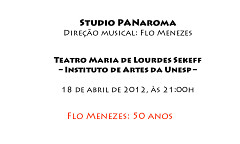
April 18, 2012São Paulo (Brazil)
- June 17, 2006São Paulo (Brazil)
- December 11, 2002São Paulo (Brazil)
- September 12, 2002Montréal (Québec)

- October 29, 2000São Paulo (Brazil)